Cremona Conference 2026 - Week 1
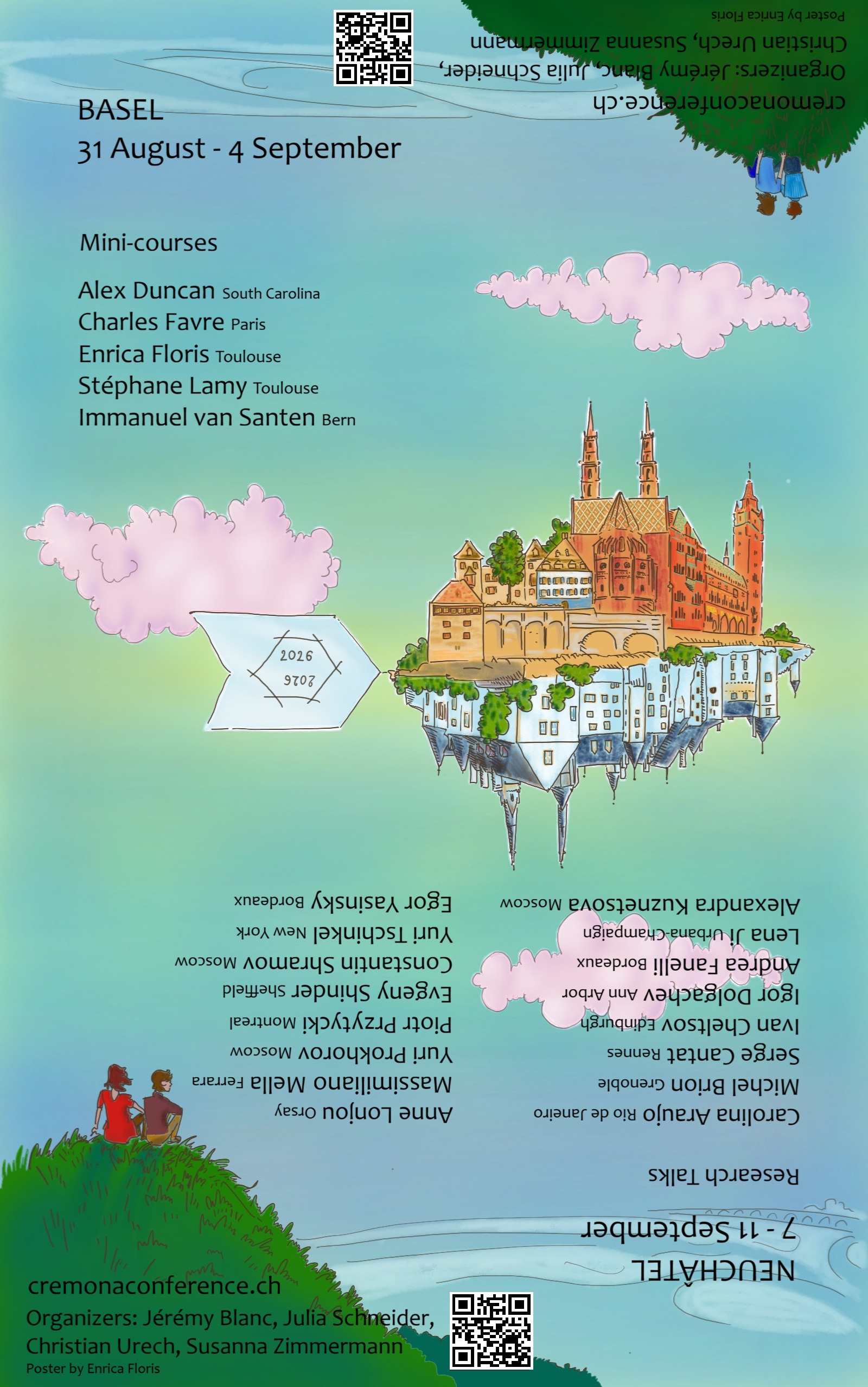
Location
Speakers
Charles Favre (Paris)
Enrica Floris (Toulouse)
Stéphane Lamy (Toulouse)
Immanuel van Santen (Bern)
Schedule
Kollegienhaus, HS 118
| 9:00–9:30 | Registration |
| 9:30–10:20 | Stéphane Lamy |
| 10:50–11:40 | Enrica Floris |
| 11:50–12:40 | Alexander Duncan |
| lunch break | |
| 14:00–14:50 | Charles Favre |
| 15:20–16:10 | Piotr Przytycki |
| Apéro |
Kollegienhaus, HS 118
| 9:30–10:20 | Immanuel van Santen |
| 10:50–11:40 | Stéphane Lamy |
| 11:50–12:40 | Enrica Floris |
| lunch break | |
| 14:00–14:50 | Alexander Duncan |
| 15:20–16:10 | Charles Favre |
Kollegienhaus, HS 118
| 9:30–10:20 | Charles Favre |
| 10:50–11:40 | Immanuel van Santen |
| 11:50–12:40 | Stéphane Lamy |
| free afternoon |
Kollegienhaus, HS 118 (morning) and Vesalianum (afternoon)
| 9:30–10:20 | Alexander Duncan |
| 10:50–11:40 | Charles Favre |
| 11:50–12:40 | Stéphane Lamy |
| lunch break | |
| 14:00–14:50 | Immanuel van Santen |
| 15:20–16:10 | Enrica Floris |
Vesalianum
| 9:30–10:20 | Alexander Duncan |
| 10:50–11:40 | Enrica Floris |
| 11:50–12:40 | Immanuel van Santen |
Titles and abstracts
Alexander Duncan — Finite subgroups of Cremona Groups
We survey the classification of finite subgroups of Cremona groups. The discussion will be centered on the case of the plane Cremona group over the complex numbers, where the classification is most complete. However, more recent developments in positive characteristic and over non-closed fields will also be discussed. We will also touch upon what is known in dimension three and higher.
Charles Favre — Regularization of birational transformations
We shall discuss the problem of describing which birational self-maps of a projective variety are birationally conjugated to an automorphism (regularizable maps). We will review criteria based on the dynamical degrees ensuring regularizability and conversely develop obstructions to regularization.
Enrica Floris — Maximal algebraic subgroups in the Cremona group
We will explain how techniques from the minimal model programme can be used to study algebraic subgroups of the Cremona group.
We will give various examples of maximal subgroups and of subgroups which are not contained in a maximal one.
Stéphane Lamy — Tits alternative for the Cremona group
A group G satisfies the Tits alternative if every subgroup of G contains either a solvable group of finite index, or a free group on two generators. Jacques Tits’s classic result is that the linear groups GL(n,K) satisfy this alternative, provided we restrict to subgroups of finite type when the ground field K has positive characteristic.
In this mini-course, I will discuss Tits’ alternative for the Cremona group of rank 2, including a version for positive characteristic.
This will also be an opportunity to present various classification results for Cremona transformations, notably the classification in terms of the growth of the degrees of the iterates (bounded, polynomial, or exponential growth), and the dictionary with the action on an infinite-dimensional hyperboloid (elliptic, parabolic, or loxodromic action).
Immanuel van Santen — Algebraic families of automorphisms and solvability
This mini-course is based primarily on joint work arXiv:2605.13515 and arXiv:2605.13510 with Serge Cantat, Hanspeter Kraft, and Andriy Regeta.
The group of algebraic automorphisms Aut(X) of a variety X can be extremely large and rich, for example when X is the affine space. A useful philosophy for understanding Aut(X) is to mimic results from the theory of algebraic groups. In particular, algebraic group actions on X give rise to the notion of algebraic subgroups of Aut(X). More generally, there is a natural notion of a family of automorphisms, which leads to concepts of connectedness and dimension, first introduced by Ramanujam.
A central question addressed in this mini-course is: given an irreducible family of automorphisms of X containing the identity, under which conditions does it generate an algebraic subgroup of Aut(X)? When the members of the family commute pairwise and X is affine, a result of Cantat, Regeta, and Xie shows that such a family indeed generates an algebraic subgroup. We extend this result to the case where the family generates a solvable subgroup and X is only assumed to be quasi-affine.
In the mini-course, I will present the proof of this result along with several applications. These include a structure theorem for connected solvable subgroups analogous to the classical case of connected solvable affine algebraic groups, a bound on the derived length of a Borel subgroup of Aut(X) in terms of dim X, and a characterization of the affine space among connected quasi-affine varieties via these Borel subgroups.
Piotr Przytycki — A CAT(0) space for the tame automorphism group
Let k be a field of characteristic 0. The tame automorphism group Tame(k^3) is the group of transformations of k^3 generated by the affine maps and the maps of the form (x_1,x_2,x_3)-> (x_1+P,x_2,x_3), where P is a polynomial in x_2,x_3. We will describe an action of Tame(k^3) by isometries on a simply connected nonpositively curved metric space, which leads to several applications. This is joint work with Stéphane Lamy.