Cremona Conference 2026 - Week 2
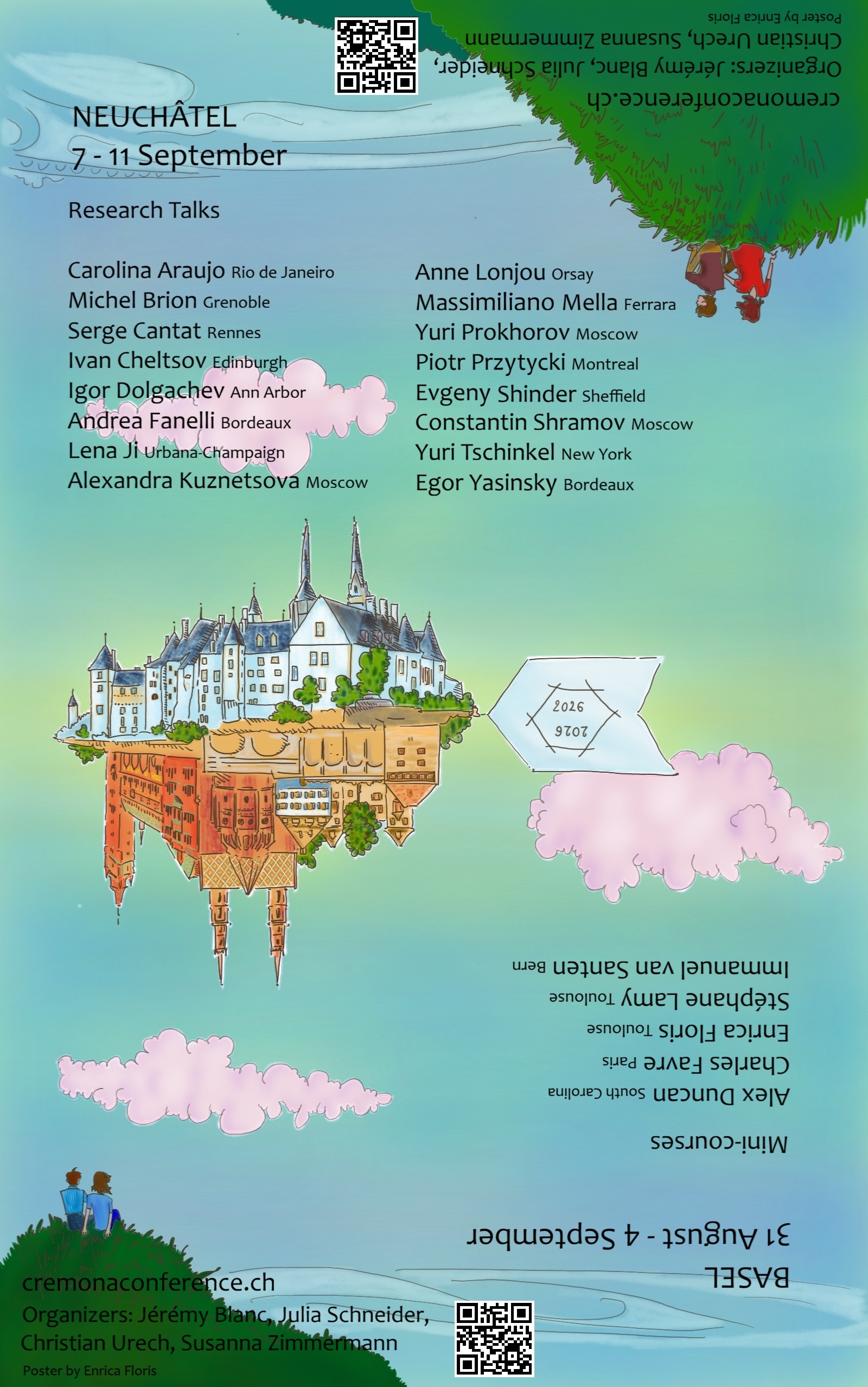
Speakers
Serge Cantat (Rennes)
Ivan Cheltsov (Edinburgh)
Igor Dolgachev (Ann Arbor)
Andrea Fanelli (Bordeaux)
Lena Ji (Urbana-Champaign)
Anne Lonjou (Orsay)
Massimiliano Mella (Ferrara)
Evgeny Shinder (Sheffield)
Constantin Shramov (Moscow)
Isabel Stenger (Hannover)
Yuri Tschinkel (New York)
Egor Yasinsky (Bordeaux)
Zhixin Xie (Nancy)
Location
Schedule
| 9:00–9:30 | Registration |
| 9:30–10:20 | Igor Dolgachev |
| 11:00–11:50 | Yuri Tschinkel |
| lunch break | |
| 14:00–14:50 |
Chris Karpinski Anastasia Vikulova Hao Zhang Zhuang He |
| 15:30–16:10 | Vicente Monreal Elias Kurz Sai Krishna |
| 17:30 | boat cruise Neuchâtel-Cudrefin- Pontalban-Neuchâtel |
| 9:30–10:20 | Ivan Cheltsov |
| 11:00–11:50 | Serge Cantat |
| lunch break | |
| 14:00–14:50 | Alonso Beaumont Prajwal Samal Pier Roberto Pastorino Marc Abboud |
| 15:30–16:30 | Pascal Fong Michael Chitayat Claudia Stadlmayr Saverio Secci Eduardo Alves da Silva |
| 17:30 | Poster session / Apéro |
| 9:00–9:50 | Andrea Fanelli |
| 10:20–11:10 | Lena Ji |
| 11:20–12:10 | Egor Yasinsky |
| 15:30 | meeting at Place Pury (near statue) and guided tour of the city |
| 9:30–10:20 | Massimiliano Mella |
| 11:00–11:50 | Isabel Stenger |
| lunch break | |
| 14:00–14:50 | Michel Brion |
| 15:30–16:20 | Anne Lonjou |
| 18:00 | Apéro |
| 9:00–9:50 | Constantin Shramov |
| 10:20–11:10 | Evgeny Shinder |
| 11:20–12:10 | Zhixin Xie |
Titles and abstracts
(alphabetical order)
Michel Brion — Projective homogeneous varieties over a field
The objects of the talk are the projective algebraic varieties over a field that are homogeneous under a semisimple algebraic group G. Such varieties are well understood in characteristic 0: they are the flag varieties G/P (where P is a parabolic subgroup of G) and their forms, for example the Severi-Brauer varieties. The situation is more complicated in positive characteristic, since parabolic subgroups may be non-smooth.
The talk will present the classification of projective homogeneous varieties over an algebraically closed field of characteristic p > 0, due to Wenzel (1989) for p > 3 and Matilde Maccan (2024-2025) for p = 2,3, and its generalization to an arbitrary field based on work in progress with Maccan and Srimathy Srinivasan. In particular, varieties of Picard rank 1 are "almost as expected" and many new phenomena arise in higher Picard rank.
Serge Cantat — On the cohomological complexity of groups of automorphisms
Let X be a complex projective variety. The group of automorphisms Aut(X) acts on the cohomology of X, for instance on the second cohomology group H^2(X;\Z). This gives a linear representation of Aut(X) in GL(H^*(X;\Z)). The problem I will discuss is the following : how can we measure the complexity of the image of Aut(X) in GL(H^*(X;\Z)) ? How does it depend on the geometry of X, or on the dimension of X ?
Ivan Cheltsov — Almost simple subgroups in the space Cremona group
I will talk about the work of my PhD student Sebastian Fuentes who classified almost simple finite subgroups in the space Cremona group.
Igor Dolgachev — Finite Cremona groups in positive characteristics
Andrea Fanelli — Maximal algebraic subgroups in the Cremona groups: bonus track
In this talk, complementary to Enrica’s course during the first week in Basel, I will explore further aspects of maximal connected algebraic subgroups in Cremona groups, via explicit birational geometry.
Lena Ji — Degree two rational multisections of conic bundles
The Enriques criterion for unirationality of conic bundles states that if X is a conic bundle over P^2 , then X is unirational if and only if the conic bundle admits a rational multisection. Furthermore, if X is unirational but not rational, then such a rational multisection necessarily has even degree. In this talk, we study non-existence of degree 2 rational multisections. This is joint work with Jeffrey Diller and Eric Riedl.
Anne Lonjou — The graph of connected algebraic subgroups
In this talk, I will present a joint work with Stéphane Lamy where we constructed a new graph, the graph of connected algebraic subgroups. The motivation was to find a rigid graph, meaning a graph such that any automorphism of this graph is induced by an automorphism of the Cremona group.
Massimiliano Mella — Cremona Equivalence
Two reduced projective schemes are said to be Cremona equivalent if there is a Cremona modification sending one onto the other. In the last decades Cremona equivalence has been investigated widely and we have now a complete theory for non divisorial reduced schemes. The case of irreducible divisors is completely different and not much is known beside the case of plane curves and few classes of surfaces.
In this talk I will provide a gentle introduction to the state of the art, recall the, somewhat surprising, result of reduced schemes in codimension 2 and study in detail the class of smooth surfaces generically projected in P^3, where an unexpected relation with sectional genus seems to appear.
Evgeny Shinder — Beyond motivic invariants
I will explain the construction of universal additive invariants from the groupoid of birational maps to abelian groups, and its relationship to the abelianization of the Cremona group. These universal invariants lift both the motivic invariants and the more precise invariants constructed by Anthony Genevois, Anne Lonjou, and Christian Urech. I will also explain when the motivic invariants coincide with the Genevois–Lonjou–Urech invariants and state some open questions. This is partly based on joint work with Hsueh-Yung Lin and partly on joint work with Julia Schneider and Sokratis Zikas.
Constantin Shramov — Intersection of two quadrics
I will talk about the birational geometry of del Pezzo surfaces of degree 4, that is, smooth intersections of two quadrics. In particular, we will discuss a classification of their birational models and properties of birational automorphism groups.
Isabel Stenger — On the Cone Conjecture beyond varieties with trivial canonical class - Part I
The birational geometry of a projective variety is closely intertwined with the structure of its cones of divisors. For Fano varieties, the nef and the movable cones are rational polyhedral, while for varieties with trivial canonical class, the Morrison–Kawamata cone conjecture predicts that the effective nef cone and the effective movable cone are rational polyhedral up to the action of suitable automorphism groups. This naturally leads to a question: is there is a unified description of these cones for a broader class of varieties including both cases?
This is the first of two talks on a joint work with Vladimir Lazić and Zhixin Xie, aimed at answering this question in dimension 2. I begin by introducing the class of klt Calabi-Yau generalised pairs, which includes all smooth varieties with nef anticanonical class. I then explain why the automorphism groups are no longer sufficient in this broader setting and describe, in dimension 2, the group of Cremona isometries that takes their place.
Yuri Tschinkel — Cohomological obstructions to equivariant birationality
I will discuss new invariants in equivariant birational geometry (joint with A. Kresch, F. Scavia, and Zh. Zhang)
Zhixin Xie — On the Cone Conjecture beyond varieties with trivial canonical class - Part II
I will continue to present the joint work with Isabel Stenger and Vladimir Lazić. The aim of this talk is to describe the nef cone of surfaces having the structure of a klt Calabi-Yau generalised pair by means of the group of Cremona isometries. I will first explain how the problem is reduced to considering surfaces obtained by blowing up nine points on the projective plane. I will then focus on this kind of surfaces and discuss the relation between their group of Cremona isometries and certain Weyl group. In particular, using properties on the Weyl groups, this allows to show that there is a rational polyhedral fundamental domain for the action of the group of Cremona isometries on the nef cone.
Egor Yasinsky — Birational geometry of sextic del Pezzo surfaces
In this talk, we will consider del Pezzo surfaces over non-closed fields. We will discuss their birational classification and see that del Pezzo surfaces of degree 6 exhibit rather unusual birational properties among del Pezzo surfaces. Based on joint works with E. Kurz.
Short talks
(ordered by appearance)